
How do human muscle fibres age?
Human skeletal muscle serves many vital functions, from enabling movement to regulating metabolism and storing of key nutrients needed for muscle health. It is a complex tissue composed of various cells—mostly muscle fibres—that undergo a profound transformation as we age.
Our review, led by the AGE Research Group and undertaken in collaboration with colleagues from Newcastle University Biosciences Institute, Northumbria University and the University of Leeds summarises what is known about the intricate structural, cellular and molecular changes that occur in our muscles over time, as we age. It focuses on Vastus Lateralis—the large muscle in the thigh essential for walking.
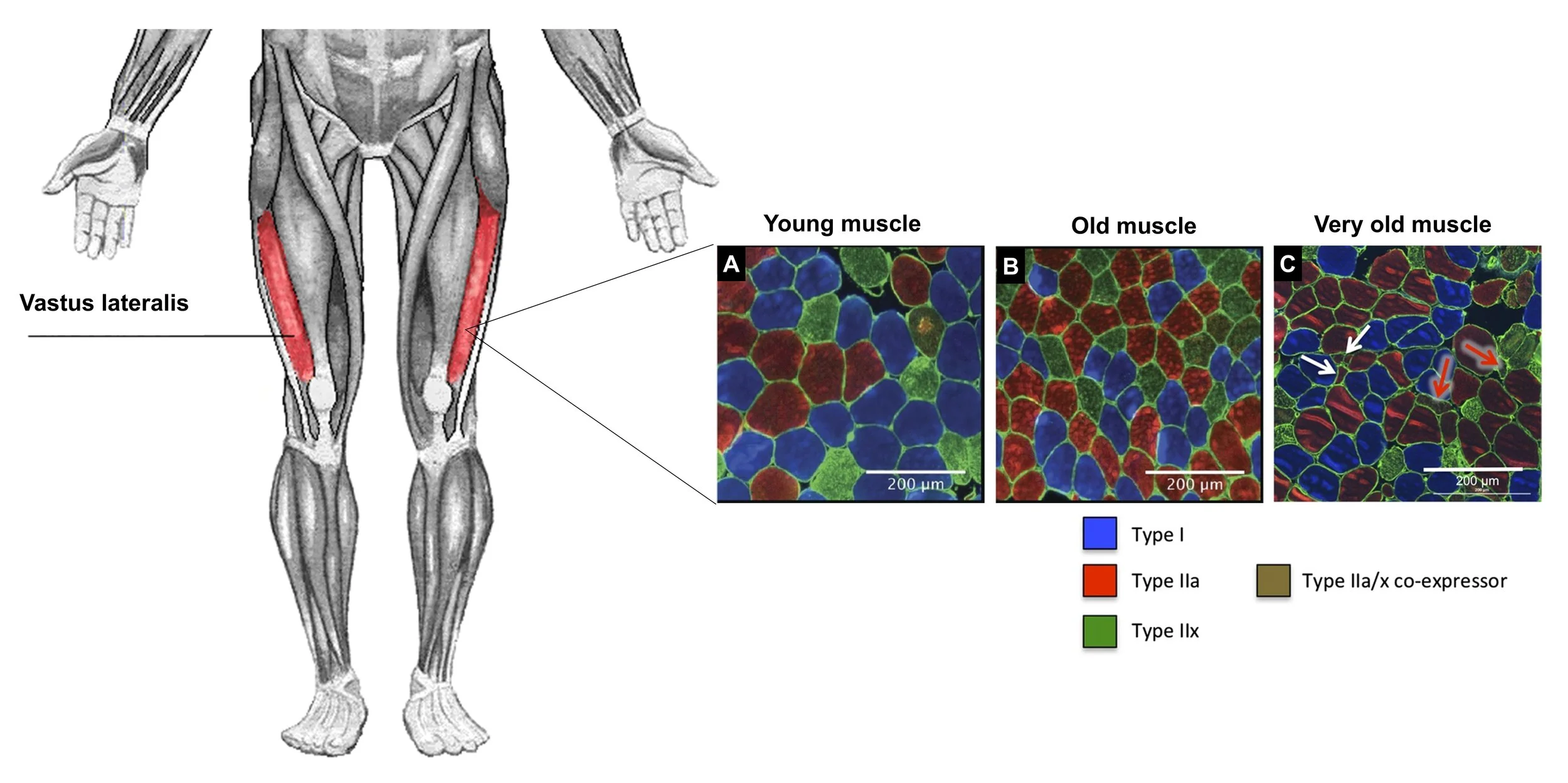
Vastus Lateralis anatomy and muscle fibre structure in young and old adults.
(Reused with permission from sv.wikipedia [left panel], and Kirkeby and Garbarsch, 2000 [right panel]).
Our muscles are broadly composed of two types of muscle fibres and their supporting cells. Type I (slow-twitch) fibres are built for endurance and steady energy, and Type II (fast-twitch) fibres are responsible for power, speed, and sudden movements. Supporting cells such as immune, satellite, and blood-vessel cells assist the fibres and keep muscle healthy.
The review highlights that sarcopenia—the age-related loss of muscle mass and function—is most strongly linked to the loss of Type II (fast-twitch) fibres. These power-generating fibres tend to shrink or disappear more frequently than their endurance-focused counterparts.
While research is ongoing to uncover why these specific fibres are more vulnerable to ageing, the review points to several likely mechanisms. These include reduced nutrient sensing (when our muscle becomes less efficient at turning nutrients into muscle protein), mitochondrial decay (when the ‘power plants’ of the muscle cells begin to fail), and a breakdown of communication between nerves and muscle fibres, known as neuromuscular junction weakness.
By mapping these structural, cellular, and molecular changes in muscle during the normal process of ageing, the review provides critical insights into current evidence while highlighting key knowledge gaps.
To tackle sarcopenia, we must first understand the complex cellular and molecular landscape of the ageing muscle. This review brings us one step closer to identifying mechanisms that could be targeted to preserve muscle mass and function as we age.
Reference: Granic A, Simoes DCM, Bowen TS, Almaghtuf N, Richardson G, Sayer AA. Ageing of human myofibres in the Vastus Lateralis muscle: A narrative review. Ageing Res Rev. Published online January 6, 2026. doi:10.1016/j.arr.2026.103022