
ADMISSION
Research Collaborative

Transforming understanding of multiple long-term conditions (MLTC) in people admitted to hospital

Addressing critical gaps in our understanding of MLTC in hospitals

Delivering the knowledge needed to transform NHS systems of care for people with MLTC admitted to hospital

Integrating expertise from different academic disciplines and clinical specialities alongside lived experience
Multiple long-term conditions (MLTC) are highly prevalent among people admitted to hospital. However, hospital systems are currently largely designed for the treatment of single conditions and so are not equipped to provide effective and efficient care for people living with MLTC.
When compared with people living with no or a single long-term condition, people living with MLTC experience higher symptom and treatment burden, reduced quality of life, more complex care needs and increased risk of emergency hospitalisation. On admission to hospital, people living with MLTC also experience greater risk of adverse outcomes including longer length of stay, inpatient mortality and readmission after discharge.
Radical transformation of NHS systems of care for people with MLTC admitted to hospital is required to ensure our NHS is ‘fit for the future’. This must be informed by robust evidence. However, most research on MLTC to date has been conducted in primary care or the general population with comparatively little work undertaken in the hospital setting; an important evidence gap which the ADMISSION Research Collaborative has focused on addressing.
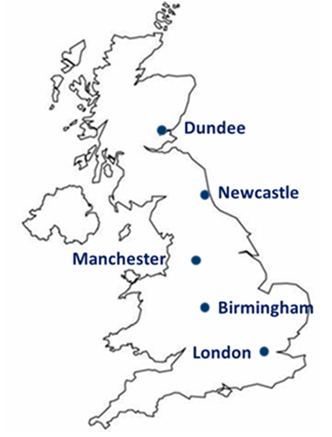
The ADMISSION Research Collaborative, led by the AGE Research Group at Newcastle University and involving co-investigators from 5 UK centres, was funded by the UK Research and Innovation and the National Institute for Health and Care Research Strategic Priority Fund ‘Tackling Multimorbidity at Scale’ (2021 – 2025).

The main aim of ADMISSION was to deliver the knowledge needed to transform NHS systems of care for people with MLTC admitted to hospital.
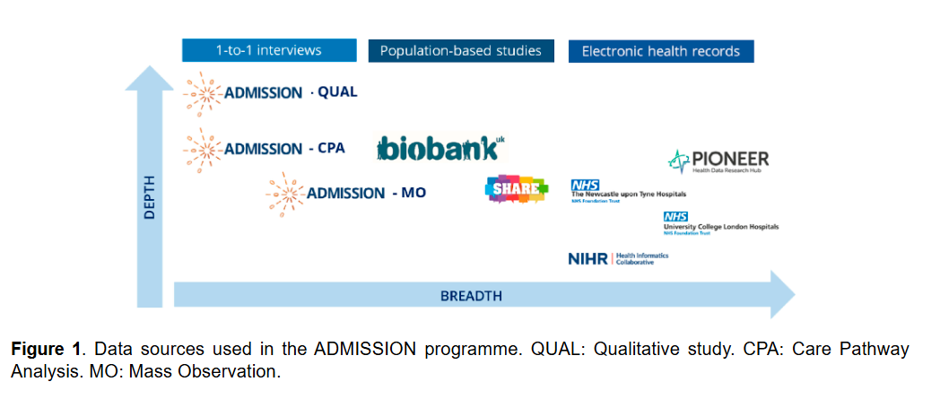
To achieve this, we have examined patterns of MLTC among people admitted to hospital and investigated risk factors, underlying mechanisms, lived experience and pathways of care. This work has been undertaken using a wide range of data including routinely collected electronic health records from large UK teaching hospitals, population-based cohort data from UK Biobank, routinely collected blood samples from the Scottish Health Research Register and Biobank (SHARE) and qualitative data generated by interviewing people with MLTC admitted to hospital and healthcare professionals (Figure 1).
ADMISSION involved an interdisciplinary team with expertise in medicine, epidemiology, health informatics, computing, statistics, social science, genetics and care pathway mapping. Patient and Public Involvement was embedded throughout the programme from design to dissemination with regular input provided by two public co-investigators and a diverse and highly engaged patient advisory group.
Source: Witham et al. 2025
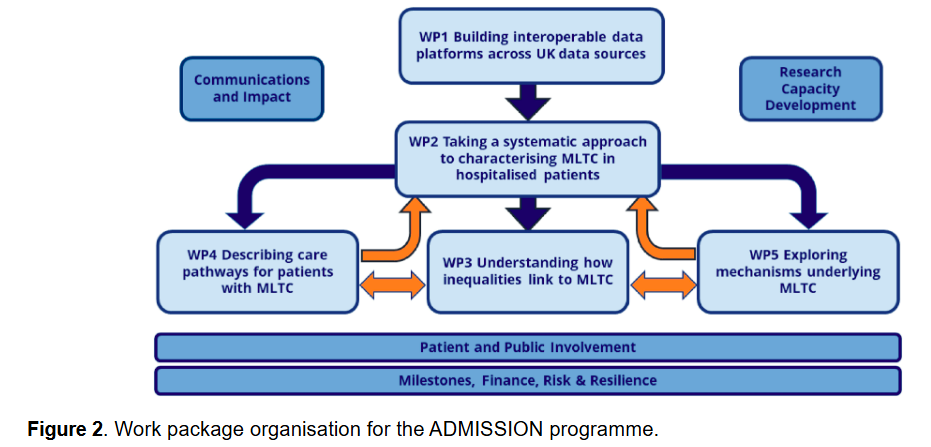
Alongside cross cutting work packages focusing on Patient and Public Involvement and Research Capacity Development, ADMISSION comprised five scientific work packages (Figure 2) with the following objectives:
To build an aligned, curated, interoperable data platform containing routinely collected data from hospitalised patients across the acute care pathway
To use a range of analytic approaches to describe the risk factors and outcomes of multiple long-term conditions in people admitted to hospital in the UK
To investigate key drivers of inequality in MLTC within hospital settings and explore their impacts on health care pathways and outcomes
To map conditions in the context of patient pathways to understand hospital-based health service use, antecedent events and consequences after admission
To identify biological mechanisms underpinning groups of long-term conditions commonly seen in people admitted to hospital
By taking an integrative, interdisciplinary approach, and working in partnership with patients and the public, ADMISSION has developed a comprehensive picture of MLTC in the hospital setting. We have:
described the rationale and content of the ADMISSION Research Collaborative
outlined principles to guide selection of long-term conditions when defining MLTC in a UK hospital setting, resulting in a 60-condition list which has been mapped to ICD-10 codes to improve consistency and transparency in the operationalisation of MLTC
highlighted the scale of the challenge that MLTC present in the hospital setting; overall prevalence of MLTC among people admitted to hospital in the North East of England is high and has increased since the Covid-19 pandemic
used PIONEER data to map care pathways during hospital admission for patients with COPD, as an exemplar
reviewed 56 single-condition NICE guidelines and proposed recommendations for improving the relevance of clinical guidelines for people living with MLTC
described the experience of people living with MLTC who have had recent hospital stays and hospital clinicians’ decision-making processes
disseminated research findings and built sustainable collaborative networks by hosting annual UK MLTC symposia
-
Bellass S, Scharf T, Bartle V, Sayer AA, Cooper R Public Perceptions of Multiple Long-Term Conditions: An Analysis of Mass Observation Accounts. Health Expectations. 2026 Sep;29(5):e70868
Richardson SJ, Bunn JG, Evison F, Gallier S, Harris S, le Roux P, Plummer C, Prendergast E, Sapey E, Sayer AA, Singer M, Shahmandi M, Witham MD; ADMISSION Collaborative Understanding the impact of Multiple Long-Term Conditions (MLTC) on the completion of delirium screening documentation: analysis using routinely collected clinical data. European Geriatric Medicine. 2026 Sep 20. doi: 10.1007/s41999-026-01594-9. Online ahead of print.
Shahmandi M, Bunn JG, Elewa C, Marshall TP, Leroux P, Plummer C, Witham MD, Sayer AA, Cooper R and Wason JMS on behalf of the ADMISSION Research Collaborative The performance of latent class analysis for clustering multiple long-term conditions is robust to the impact of high prevalence conditions Journal of Clinical Epidemioly. 2026 Sep:197:112388
Cooper R, Shahmandi M, Bunn JG, Leroux P, Plummer C, Marshall TP, Wason JMS, Witham MD and Sayer AA on behalf of the ADMISSION Research Collaborative A National Health Service in ‘Serious Trouble’: what do multiple long-term conditions tell us about deterioration in health among people accessing hospital care in the North East of England? – an analysis of electronic health records JRSM Open. 2026 Aug 4;17(8):20542704261465142
Bellass S, Ellwood A, Arakelyan S, Bowers SP, Dewhurst F, Hanley SJ, Hayanga B, Hopkins SA, Howe N, Hunt E, Lewis G, Lippiett K, McCloskey E, Pretorius S, Salonen D, Shoemark-Sells EZ, Thompson A, Thompson F, Vowles Z, Walker H, Wheat H Recommendations for conducting qualitative research on multiple long-term conditions (MLTC) from a qualitative methods community of practice Journal of Multimorbidity and Comorbidity. 2026 Jun 10;16:26335565261459508
Pretorius S, Bartle V, Bellass S, Blackburn E-R, Bold H, Cooper R, Cordell HJ, Evison F, Holding R, Howe N, Lam E, Marshall T, Matthews FE, Missier P, Pearson ER, Plummer C, Richards G, Robinson SM, Sapey E, Scharf T, Singer M, Suklan J, Wason JMS, Walker P, Sayer AA and Witham MD Making clinical guidelines work for people with multiple long term conditions: analysis and recommendations from review of single condition guidelines BMJ Med. 2026 Feb 23;5(1):e001495. eCollection 2026
Nair ATN, Witham M, Sayer AA, Cordell HJ, Pearson ER; ADMISSION Research Collaborative. Exploring the genetic architecture of multiple long-term conditions using a genome-wide association study in the UK Biobank population Scientific Reports. 2025 Dec 6;15(1):44096
Howe N, Blackburn E, Sheppard A, Pretorius S, Suklan J, Bellass S, Cooper R, Gallier S, Sapey E, Sayer AA, Witham MD Clinical decision-making and care pathways for people with multiple long-term conditions admitted to hospital: a scoping review BMJ Open. 2025 Aug 4;15(8):e100270
Darlay R, Shah RL, Dodds RM, Nair ATN, Pearson ER, Witham MD, Cordell HJ Exploring Similarities and Differences Between Methods That Exploit Patterns of Local Genetic Correlation to Identify Shared Causal Loci Through Application to Genome-Wide Association Studies of Multiple Long Term Conditions Genetic Epidemiology. 2025 Jul;49(5):e70012
Thompson F, Bellass S, Scharf T, Witham MD and Cooper R Perceptions of Hospital Care Quality According to People Living With Multiple Long-Term Conditions: A Scoping Review Health Expect. 2025 Jun;28(3):e70297
Bunn JG, Steell L, Hillman SJ, Witham MD, Sayer AA, Cooper R Approaches to characterising multimorbidity in older people accessing hospital care: a scoping review European Geriatric Medicine. 2025 Aug;16(4):1099-1113. Epub 2025 Mar 1
Witham MD, Bartle V, Bellass S, Bunn JG, Cartner D, Cordell HJ, Doal R, Evison F, Gallier S, Harris S, Hillman SJ, Holding R, Leroux P, Marshall T, Matthews FE, Missier P, Nair A, Osman M, Pearson ER, Plummer C, Pretorius S, Richardson SJ, Robinson SM, Sapey E, Scharf T, Shah R, Shahmandi M, Singer M, Suklan J, Wason J, Cooper R, Sayer AA Building ADMISSION - A research collaborative to transform understanding of multiple long-term conditions for people admitted to hospital Journal of Multimorbity and Comorbidity. 2025 Feb 1:15:26335565251317940. eCollection 2025 Jan-Dec
Bellass S, Scharf T, Errington L, Davies KB, Robinson S, Runacres A, Ventre J, Witham MD, Sayer AA, Cooper R Experiences of hospital care for people with multiple long-term conditions: a scoping review of qualitative research BMC Medicine. 2024 Jan 17:22(1):25
Hillman SJ, Dodds RM, Granic A, Witham MD, Sayer AA, Cooper R Identifying combinations of long-term conditions associated with sarcopenia: a cross-sectional decision tree analysis in the UK Biobank study BMJ Open. 2024 Sep 5;14(9):e085204
Richardson SJ, Croppp AD, Ellis SW, Gibbon J, Sayer AA, Witham MD The interrelationship between multiple long-term conditions (MLTC) and delirium: a scoping review Age Ageing. 2024 Jul 2;53(7):afae120
Osman M, Cooper R, Sayer AA, Witham MD The use of natural language processing for the identification of ageing syndromes including sarcopenia, frailty and falls in electronic healthcare records: a systematic review Age Ageing. 2024 Jul 2;53(7):afae135
McDonald C, Cooper R, Sayer AA, Witham MD Improving care for patients with multiple long-term conditions admitted to hospital: challenges and potential solutions Br J Hosp Med (Lond). 2024 Mar 2;85(3):1-8. Epub 2024 Mar 19
Cooper R, Bunn J, Richardson S, Hillman S, Sayer AA, Witham MD, ADMISSION Research Collaborative Rising to the challenge of defining and operationalising multimorbidity in a UK hospital setting: the ADMISSION research collaborative European Geriatric Medicine. 2024 Jun;15(3):853-860. Epub 2024 Mar 6
Lewis J, Evision F, Doal R, Field J, Gallier S, Harris S, Le Roux P, Osman M, Plummer C, Sapey E, Singer M, Sayer A, Witham MD, ADMISSION Research Collaborative How far back do we need to look to capture diagnoses in electronic health records? A retrospective observational study of hospital electronic health record data BMJ Open. 2024 Feb 13;14(2):e080678
Lewis J, Evision F, Doal R, Field J, Gallier S, Harris S, Le Roux P, Osman M, Plummer C, Sapey E, Singer M, Sayer A, Witham MD, ADMISSION Research Collaborative How far back do we need to look to capture diagnoses in electronic health records? A retrospective observational study of hospital electronic health record data BMJ Open. 2024 Feb 13;14(2):e080678.doi: 10.1136/bmjopen-2023-080678
Evision F, Cooper R, Gallier S, Missier P, Sayer AA, Sapey E, Witham MD Mapping inpatient care pathways for patients with COPD: an observational study using routinely collected electronic hospital record data ERJ Open Research. 2023 Oct 16;9(5):00110-2023. eCollection 2023 Sep
Witham MD, Cooper R, Missier P, Robinson SM, Sapey E, Sayer AA Researching multimorbidity in hospital: can we deliver on the promise of health informatics? European Geriatric Medicine. 2023 Aug;14(4):765-768
Dodds EM, Bunn JG, Hillman SJ, Granic A, Murray J, Witham MD, Robinson SM, Cooper R, Sayer AA Simple approaches to characterising multiple long-term conditions (multimorbidity) and rates of emergency hospital admission: Findings from 495,465 UK Biobank participants Journal of Internal Medicine. 2023 Jan;293(1):100-109. Epub 2022 Sep 21
Cooper R, Witham MD, Bartle V, Sayer AA Defining and measuring multiple long-term conditions in research BMJ Medicine. 2022 Jul 27;1(1):e000287. eCollection 2022
Study Fact File
Principal Investigator: Professor Avan Sayer
Work Package Leads: Professor Rachel Cooper, Professor Heather Cordell & Professor Miles Witham, Newcastle University
Collaborating Institutions: Newcastle University, Newcastle upon Tyne Hospitals NHS Foundation Trust, University of Birmingham (PIONEER – the Health Data Research UK Acute Care Hub), Manchester Metropolitan University, University of Dundee and University College London
Funders: UK Research and Innovation (UKRI) & National Institute for Health and Care Research (NIHR)