
Developing resources to advance understanding of skeletal muscle ageing
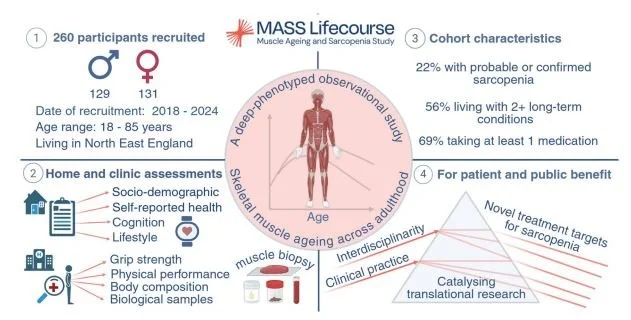
Our paper describing MASS Lifecourse, a study led by the AGE Research Group that advances understanding of skeletal muscle ageing in humans has been published in GeroScience.
Between 2018 and 2024, 260 men and women aged 18 to 85 years living in the North East of England were recruited to MASS (Muscle Ageing and Sarcopenia Study) Lifecourse. This study, supported by the NIHR Newcastle Biomedical Research Centre, was developed to facilitate cutting-edge translational ageing research — ensuring scientific discoveries are translated into real world benefits for patients and the public.
By bringing together detailed information on people’s health, lifestyle and physical function with biological samples—including muscle biopsies— the study provides an unprecedented picture of muscle health across the adult life course. Full details of the baseline assessments and characteristics of the study participants are showcased in our new paper which highlights the value of this resource.
In 2025, we embarked on a new phase of MASS Lifecourse and participants are now being invited to undertake follow-up assessments, including a second muscle biopsy, approximately five to six years after their first assessment. Liz Best, first took part in the study over four years ago and explained that the decision to participate again was an easy one.
“Looking after my body and wellbeing is a big priority for me, so when I got the invite, I didn’t hesitate to say yes,” she explains.
For Liz, MASS Lifecourse offered more than just participation in research. It provided an opportunity to better understand her physical health, including the importance of staying strong, and how this can be maintained through participation in strength training.
“There’s a lot of evidence from clinicians and researchers about the importance of strength training especially lifting weights that challenge you to help protect against the decline in muscle strength.”
Reflecting on her experience, she highlights the broader value of research participation, noting that much of the health advice people rely on today is built on studies like MASS Lifecourse.
“The information that’s available to us has come from research,” she says. “That’s why I would encourage anyone who feels able, to take part.”
Our research is not only advancing scientific understanding but is also making a real difference to the people who take part. Through ongoing follow‑up and engagement events, participants have shared how being involved has increased their awareness of their own muscle health and motivated positive lifestyle changes. We are delighted to hear about these experiences, which highlight the wide-ranging impact of the study and reinforce the importance of continuing to work closely with participants throughout.
We thank Liz for sharing her experience.
You can read the full paper published in GeroScience here: Muscle Ageing and Sarcopenia Study (MASS) Lifecourse: a valuable resource for understanding skeletal muscle ageing