
Inclusive Community Engagement in Action
Members of the AGE Research Group and Ageing, Sarcopenia and Multimorbidity Theme within the NIHR Biomedical Research Centre: Newcastle are committed to addressing the fact that many different groups of people are currently underrepresented by research. We aim to ensure that everyone has opportunities to contribute to and benefit from our research as this makes it more relevant, accessible and equitable.
As part of our commitment to supporting the meaningful inclusion of diverse communities of older people in our research, we are delighted to share details of a project led by AGE group member Helen Atkinson. This aimed to build on our established relationships with different local ethnic minority communities, to address three key objectives:
Increase awareness and understanding of research relating to ageing, sarcopenia, and multiple long-term conditions among older adults from an ethnic minority and socioeconomically disadvantaged community.
Promote research inclusion through translating the project output into Urdu, which is commonly spoken in the local community.
Develop a sustainable and long-term partnership that supports co-design approaches and increases participation in future research studies.
The project, supported by a Faculty of Medical Sciences Tilly Hale Award and an NIHR Biomedical Research Centre: Newcastle Research Inclusion Bursary, has led to the co-development of a culturally appropriate resource that will spark interest in research, raise awareness and encourage conversations about research within underserved communities.
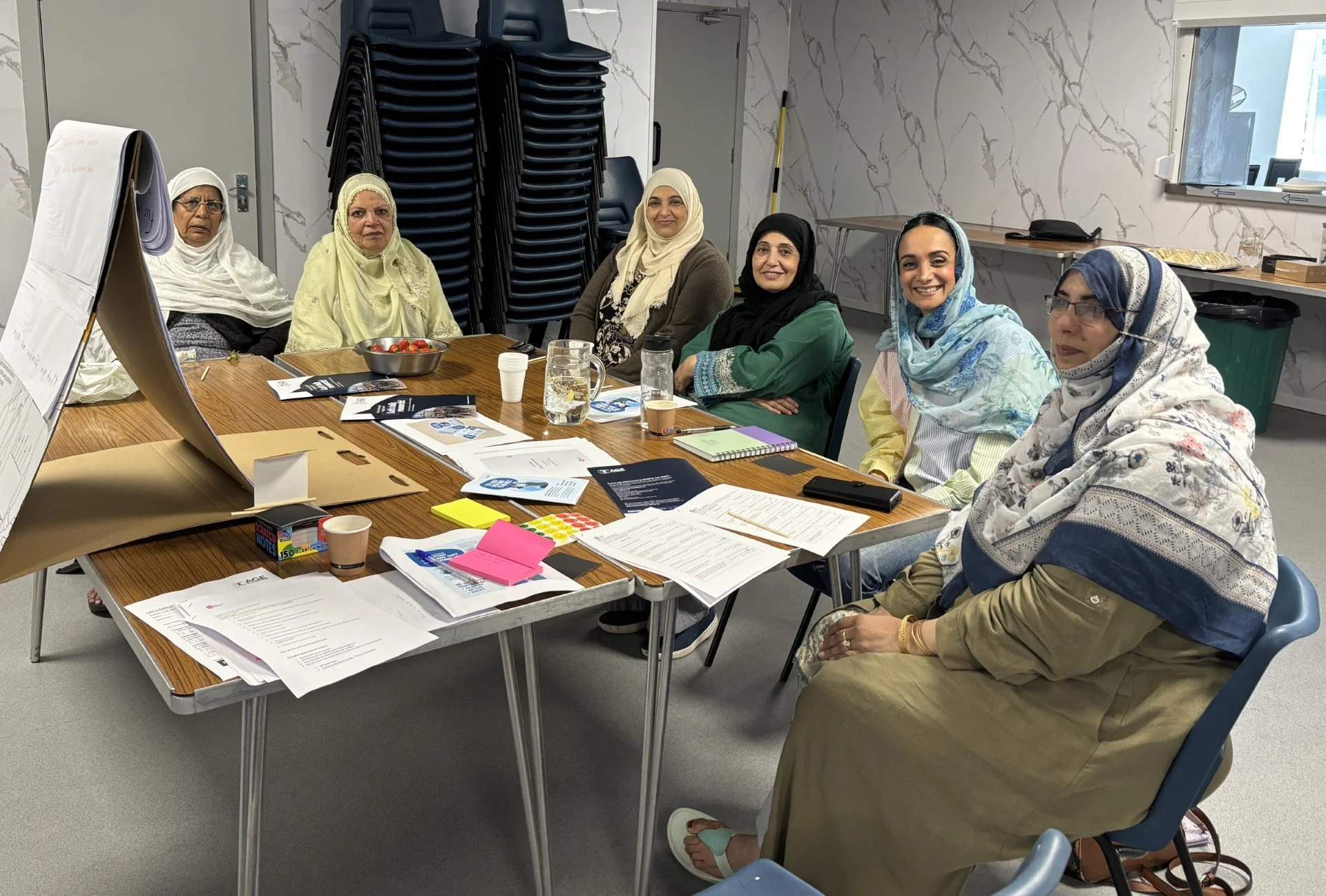
Working in partnership with members of the Rabta Group, who are a women's social group from the Bilal Jamia Masjid Mosque in Newcastle’s West End, we delivered a series of accessible and interactive workshops to gather participants' views, ideas, and recommendations that enabled us to update our existing ‘Let’s Talk Research’ resource and make it more inclusive. These insights were shared with Research Retold who used the feedback to create an accessible and culturally relevant resource that reflected the priorities and experiences of the group.
As part of the co-development process, participants shared the following reflection, which was incorporated into the final leaflet: “Happy to help the community. We want the next generation to benefit”
Participants also spoke positively about the opportunity to meet new people, learn about ageing research, and contribute to a project that could benefit others. Feedback gathered during the project demonstrated increased interest in research and a willingness to become involved in future engagement and co-design activities.
We are pleased to share the two community-facing resources produced which will be disseminated widely:
To enable us to share the learning from this innovative project with the wider research community, a practical toolkit has also been prepared:
Helen Atkinson Project lead and Patient and Public Involvement and Engagement (PPIE) Manager within the AGE Research Group, which contributes to the NIHR Biomedical Research Centre: Newcastle said:
“I’d like to thank members of the Rabta Group, whose insights and lived experiences were instrumental in the co-development of the accessible ‘Let’s talk ageing research’ resource created as a result of this project. I’d also like to thank Mehru-Nisa Shah from Connected Voice's Health and Race Equality Forum for her invaluable support throughout the project”.
A key lesson from the project was the importance of listening carefully to community members and creating opportunities for open and honest feedback. Successful co-production relies on understanding community perspectives, avoiding assumptions, and being transparent about what can and cannot be changed. By doing so, researchers can build trust, improve accessibility, and create resources that are genuinely relevant and meaningful to the communities they hope to engage.