
6 in 10 adults admitted to hospital in NE England are living with MLTC
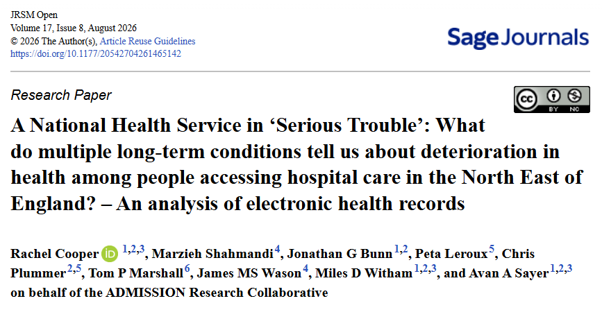
Our latest ADMISSION paper reveals a notable rise in the prevalence of multiple long-term conditions (MLTC) among adults admitted to hospital in North East England, highlighting the growing challenges for the NHS posed by MLTC.
Published in JRSM Open, the research led by members of the AGE Research Group and Ageing, Sarcopenia and Multimorbidity Theme within the NIHR Biomedical Research Centre: Newcastle involved analysis of electronic health records from more than 170,000 adults admitted to Newcastle upon Tyne Hospitals NHS Foundation Trust before and after the COVID-19 pandemic.
These analyses showed that the proportion of patients living with MLTC increased from 49.6% in 2018-19 to 61.0% in 2021-22. The proportion living with four or more conditions rose from 20% to 32%.
MLTC were common across all age groups; in 2021-22, more than one in five adults aged 18-29 years admitted to hospital had MLTC rising to over four in five adults aged 90 and over.
Our analyses also highlighted stark inequalities in MLTC linked to socioeconomic deprivation. Patients residing in the most deprived neighbourhoods were much more likely to be living with MLTC, particularly at younger ages. For example, among 30-39-year-olds admitted to hospital, those living in the most deprived areas were 74% more likely to be living with MLTC than those living in the least deprived areas.
Professor Rachel Cooper, lead author of the study, said: "Our findings show the sheer scale of the challenge that multiple long-term conditions present in hospitals. Almost two-thirds of adults admitted to hospital in Newcastle in 2021-22 were living with two or more long-term conditions, and the burden falls disproportionately on people living in more disadvantaged neighbourhoods. This is an important reminder that MLTC must be central to NHS reform, service redesign and efforts to reduce health inequalities.”
This paper was a major collaborative effort involving researchers and clinicians from Newcastle University, University of Birmingham and Newcastle upon Tyne Hospitals NHS Foundation Trust. The ADMISSION research collaborative was funded by the Strategic Priority Fund ‘Tackling multimorbidity at scale’ programme (grant number MR/V033654/1) and the work was also supported by the NIHR Biomedical Research Centre: Newcastle.
The full text of the article can be accessed here: https://doi.org/10.1177/20542704261465142