
BEPOP
Benchmarking Exercise Programme for Older People
A national benchmarking and quality improvement programme to optimise resistance exercise training for older people living with sarcopenia or frailty

Resistance (strength) training is effective at improving muscle strength for older people with sarcopenia or frailty, but it is often not delivered effectively.

Improved muscle strength promotes independence and better health for older people, and reduces the need for health and social care.

BEPOP drives improvements in the quality of care delivered by NHS physiotherapy services through a national benchmarking and feedback programme, allied to a community of practice to share knowledge and training.
NEW: Wave 3 report now available to download here.
What is BEPOP?
BEPOP is a nationwide service improvement project, run in collaboration between NIHR Newcastle Biomedical Research Centre, the British Geriatrics Society and AGILE (a professional network of the Chartered Society of Physiotherapists).
The initiative aims to drive development and uptake of best practice for exercise interventions for older people living with sarcopenia and frailty in the UK.
BEPOP is not a research project – it is a service improvement project. As such, research ethics approval is not required to take part, and sites do not need any experience or expertise in research to contribute.


Why focus on sarcopenia and frailty?
Sarcopenia, a reduction in muscle strength and function, and the related syndrome of physical frailty, are common conditions affecting many older people. They cause falls, fractures, and lengthy hospital admissions, increase dependence and worsen quality of life. A growing body of evidence supports resistance exercise training as a safe and effective intervention for sarcopenia and frailty. However, our surveys of current practice in the UK found that resistance training was offered in only 9% of departments delivering exercise interventions to older people.
Debate continues as to the best way to deliver evidence-based exercise training for older people with sarcopenia and frailty, for example: How many sessions are needed? How frequent should sessions be? How should progress be measured and exercise intensity increased? What modes of exercise work best? Previous UK surveys of practice have found great variation in all of these aspects of exercise programme delivery.
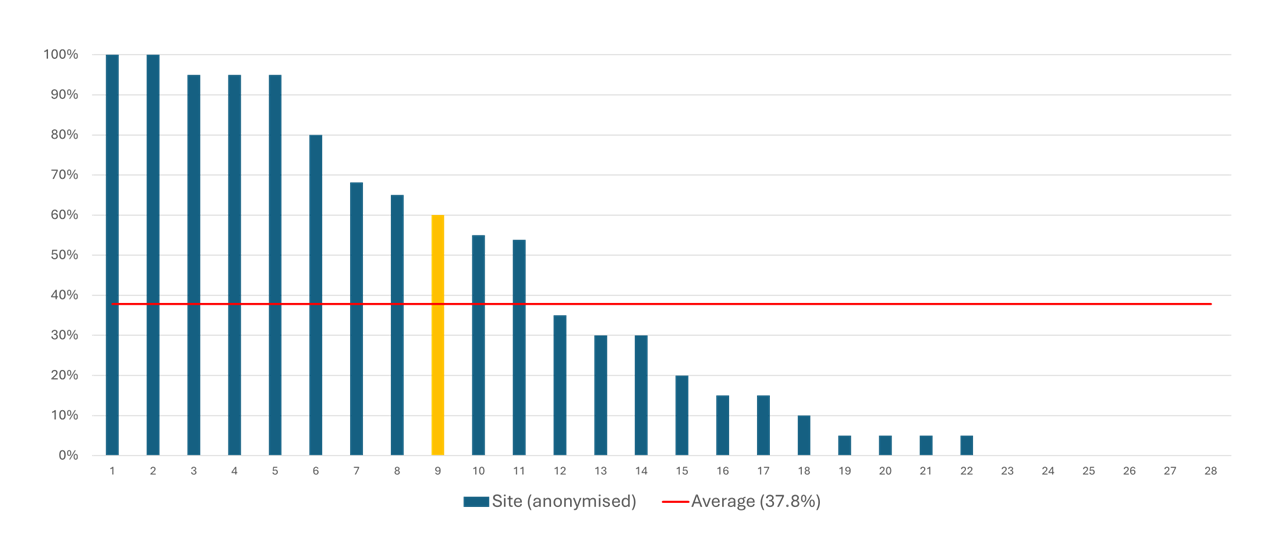
Example of benchmarking feedback to sites
What have we done so far?
Wave 1 of BEPOP completed in 2023 and we have published a report of the findings along with recommendations to improve practice: BEPOP Wave 1 Report. We have now completed analysis of data from Wave 2 (2024-5; 542 individuals across 28 services): BEPOP Wave 2 Report and data from Wave 3 (2025-6; 603 individuals across 34 services):BEPOP Wave 3 Report.
The results show a steady improvement in the quality of exercise delivery for older people with sarcopenia and/or frailty – services taking part in multiple waves of BEPOP showed the greatest improvements.
We presented the Wave 3 results at the BGS Spring conference in 2026, and we are currently planning our next BEPOP webinar, hosted by AGILE, to exchange knowledge and innovation amongst participating services and share successes and challenges. Watch our 2025 webinar: video recording available here. We have also partnered with the British Geriatrics Society to create a microlearning educational resource, available here: https://www.bgs.org.uk/getting-to-grips-with-sarcopenia. This is an ideal introduction to sarcopenia for a wide range of staff caring for older people.
How do I take part?
We are now gathering expressions of interest for taking part in future waves of data collection. If you are interested in joining BEPOP, please complete the Expression of Interest form which can be found here: https://forms.office.com/e/X1PcMHRktM.
Our team will then get in touch with you to discuss further.
Project Fact File
Our role: Joint lead with AGILE and BGS
Funders: British Geriatrics Society (BGS)
Project lead: Prof. Miles Witham
Enquiries: nuth.bepop@nhs.net